
STCs and Solar Batteries: The Other Rebate Most People Don't Know About
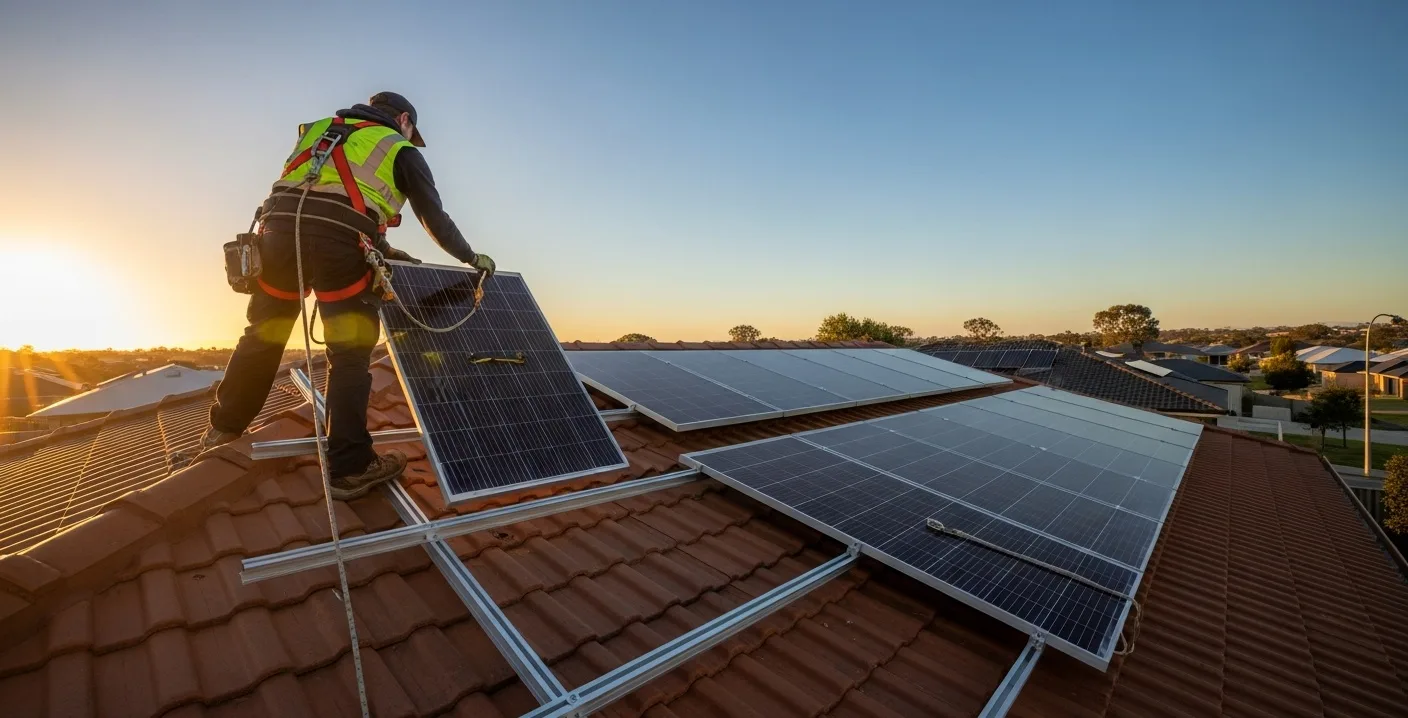
If you've ever bought a solar system in Australia and thought "that's surprisingly affordable," here's what probably happened: your installer quietly applied several thousand dollars' worth of Small-scale Technology Certificates to your invoice, called it a "government rebate," and you accepted it without asking too many questions.
That's fine. Most people don't need to understand the mechanism. But if you're about to spend $10,000–$15,000 on a battery installation, understanding STCs can actually help you make better decisions — particularly around timing.
What the Heck Is an STC?
STC stands for Small-scale Technology Certificate. It's a certificate created under the federal government's Small-scale Renewable Energy Scheme (SRES), which is the part of the Renewable Energy Target aimed at residential and small commercial solar systems.
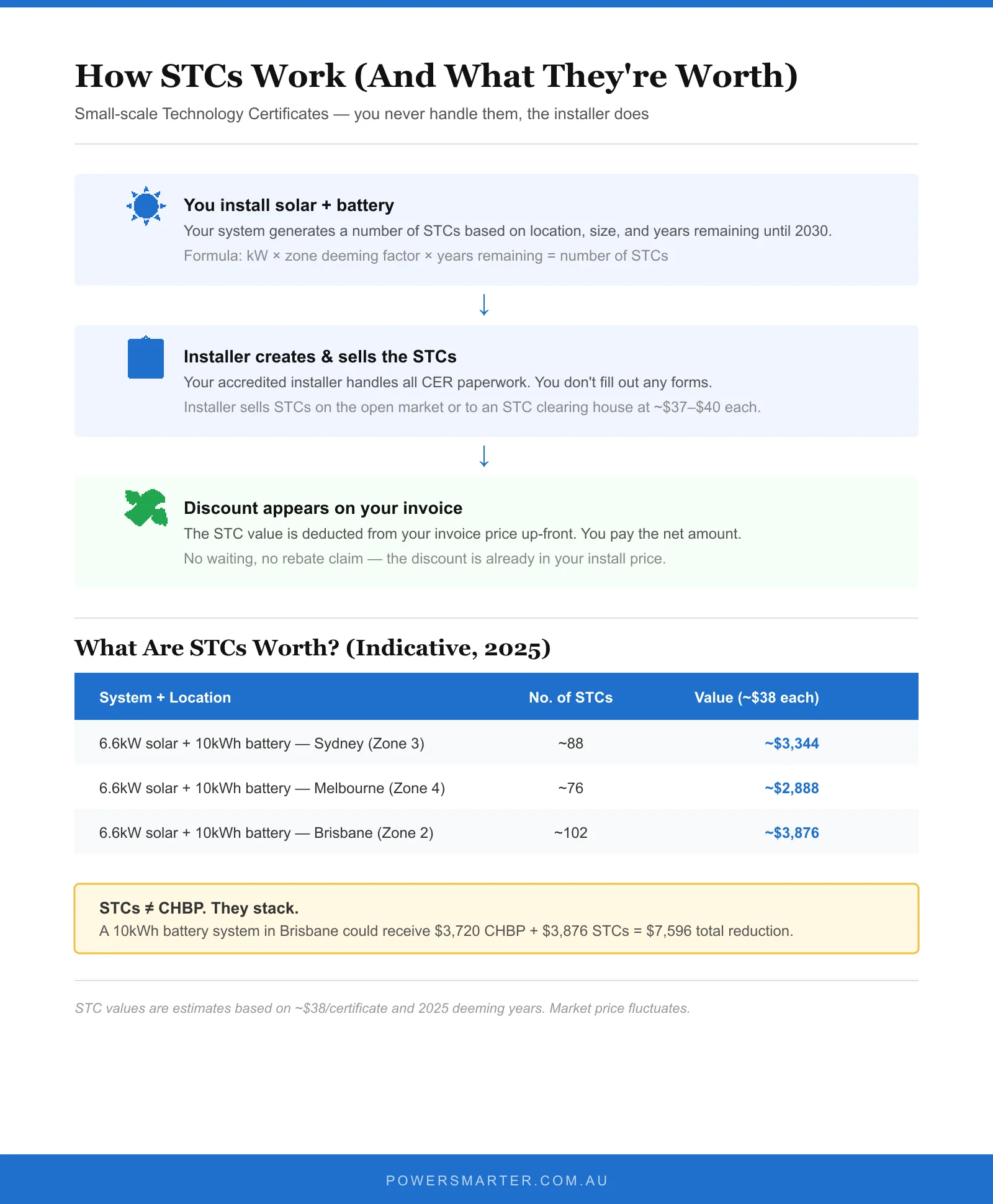
Here's the basic idea: when you install a qualifying solar (or in some cases, solar-plus-battery) system, the government deems that system will generate a certain amount of clean electricity over its lifetime. For each megawatt-hour of expected generation, you're entitled to create one STC.
These certificates have a market value. Other parties (mainly large energy companies that are obligated to purchase them under the scheme) buy them from you — or, more accurately, from your installer who buys the rights from you at the point of sale and then sells them on the market.
The net effect: your installer pays less for the STC rights than the market value of the certificates, passes some of that saving to you, and pockets a bit of margin. You get an upfront discount. The whole transaction happens before you even know about it, buried in the price comparison between "solar costs $X full price" and "we're quoting you $X minus a few grand."
How Much Are We Talking?
The value of STCs fluctuates with the spot market, but has generally been in the range of $35–$40 per certificate in 2024–2025 (according to STC market data). The number of certificates a system creates depends on its capacity and your location (because the scheme accounts for how much solar generation different parts of Australia receive — Queensland gets more than Tasmania).
For a reference: a 6.6kW solar system in Brisbane might generate around 85–90 STCs, worth roughly $3,200–$3,600 at current market prices.
A solar-plus-battery system with an eligible battery (generally ones with integrated inverters or AC-coupled systems) may generate additional STCs. This is where it gets relevant for battery buyers specifically.
The Solar-Battery STC Question
Straight up: not all batteries generate STCs independently. The eligibility depends on how the battery connects to the system.
- DC-coupled batteries (like Tesla Powerwall 3 when installed with compatible solar): The whole system (solar + battery) may be assessed together for STC creation.
- AC-coupled batteries added to an existing solar system: Trickier. The solar system already had its STCs created when it was originally installed. Adding a standalone battery later generally does not create new STCs, unless the battery includes a qualifying inverter function.
Ask your installer directly: "Do I get any STC benefit from this battery installation?" A good installer will know the answer. If they're vague, push harder or get a second opinion.
Why Timing Matters: The Annual Step-Down
Here's the critical thing about STCs: the scheme is legislated to wind down by 2030, and the number of certificates a system can create decreases by a set "deeming period" every year on 1 January.
In plain terms: the STC rebate you'd get on the same system in 2025 is higher than what you'd get in 2026, which is higher than 2027, and so on.
The step-down each year is roughly proportional — not catastrophic, but meaningful. Over the past few years, the annual reduction in STC value per system has been in the $200–$600 range for a typical residential solar installation.
This has a real implication for people planning to install solar or solar-plus-battery: there's a genuine financial reason not to delay indefinitely. The rebate you're entitled to right now is higher than the one you'll be entitled to next January.
How This Interacts with CHBP
The CHBP and STCs are separate programmes. They can be stacked.
If you're installing solar and a battery together from 1 July, you could in theory benefit from:
1. STCs on the solar portion (and potentially the battery portion, depending on configuration)
2. CHBP rebate on the battery
3. State rebate if applicable
The CHBP doesn't cancel out your STC entitlement. They come from different parts of the system.
What the CHBP does do is require an accredited installer — which conveniently happens to be the same type of installer who properly processes STC claims. So working with a reputable CHBP-accredited installer gives you the best chance of capturing all available incentives correctly.
The main takeaway: STCs are real money, they apply to most solar installations, and they decrease over time. Don't just accept an installer's quoted price at face value — ask what STC value they're factoring in, and make sure it's reflected in your quote.
Got questions about home batteries or solar? Use our free quote comparison tool to get matched with accredited local installers — no spam, no sales calls unless you want them.
Comments (0)
No comments yet. Be the first to share your thoughts!