
Can You Combine the Federal Battery Rebate With Your State's Subsidy? (Yes, Here's How)
When the CHBP was announced, one of the first questions I got from people was: "Can I use this on top of my state rebate?"
The honest answer right now is: mostly yes, but it depends on your state and the specific programmes involved.
I went through both the federal CHBP framework and the current state schemes to figure out how the stacking actually works. Here's what I found.
First, the Golden Rule
Federal programmes and state programmes are generally separate funding streams. Unless a state scheme explicitly says "cannot be combined with federal incentives," you can typically use both. The CHBP framework, from what's been published so far, does not appear to exclude households who also receive state assistance.
That said — if your state scheme involves the government directly paying a portion of the installation cost (rather than a rebate or loan), there may be conditions. Always confirm with both your state authority and your installer before signing anything.
Victoria: The Best Deal Going Right Now
Victorian households are sitting on the best combination of incentives in the country at the moment.
Here's what's available:
- CHBP (federal): ~$3,720 on a 10kWh battery
- Victorian Battery Rebate: Up to $2,950
- STCs: Roughly $1,500–$3,000 depending on your solar system
Stack all three on a 10kWh install and you're potentially looking at $8,000–$10,000 off the total cost. A battery that might retail at $13,000 installed could come down to $3,000–$5,000 out of pocket.
That's significant. Not "marketing gimmick" significant — actually significant.
The Victorian Battery Rebate and CHBP can be combined, based on Solar Victoria's existing policy framework (which doesn't restrict applicants from accessing federal rebates). But given this is a new programme, I'd suggest calling Solar Victoria directly to confirm before proceeding — just to be safe.
The interest-free loan option ($8,800) is a different product and may have different stacking rules. Again — ask before you assume.
New South Wales
NSW doesn't have a direct cash rebate for batteries at the state level the same way Victoria does, but there's the Peak Demand Reduction Scheme (PDRS) which creates Peak Reduction Certificates (PRCs) for battery installations.
These certificates have a dollar value that your installer typically factors into the quote — it functions like a rebate in practice, even if it operates differently in mechanism.
The CHBP stacks cleanly with PDRS as they're separate mechanisms:
- CHBP: ~$3,720 on 10kWh
- PDRS certificates: $1,000–$2,500 depending on system size and the current certificate price
- STCs: $1,500–$3,000
Total potential reduction: $6,000–$9,000 off installed price.
Not as rich as Victoria's combination, but still a meaningful difference from paying full price.
Queensland
Queensland has had its Battery Booster programme offering up to $4,000 on battery installations. As of mid-2025, check with the Queensland government whether the current funding round is open (these programmes go through funding tranches and aren't always accepting applications).
If Battery Booster is running concurrently with CHBP:
- CHBP: ~$3,720 on 10kWh
- Battery Booster: Up to $4,000
- STCs: $1,500–$3,000
That's potentially $8,000–$10,000 in combined incentives — right up there with Victoria.
Queensland's warmer climate also means your solar generates more year-round, which improves the battery payback calculation on top of any upfront savings.
South Australia
SA is the state that arguably blazed the trail on home batteries — the Hornsdale Power Reserve, the Tesla battery suburb stuff, the VPPs. But the headline Home Battery Scheme rebates from 2018–2020 have wound back.
What SA residents still have access to:
- CHBP: ~$3,720 on 10kWh
- SA Power Networks Demand Response VPP: If you enrol your battery, you receive credits for allowing SAPN to use some of your stored energy during peak periods. Not a one-off rebate, but ongoing value.
- Various retailer VPP programmes (Energy Locals, AGL, etc.): Similar ongoing credit structures.
- STCs: $1,500–$3,000
The ongoing VPP participation is worth factoring into your total economics — over 5–7 years, it can add up to several thousand dollars in bill credits, which changes the payback calculation meaningfully.
A Rough Comparison Table
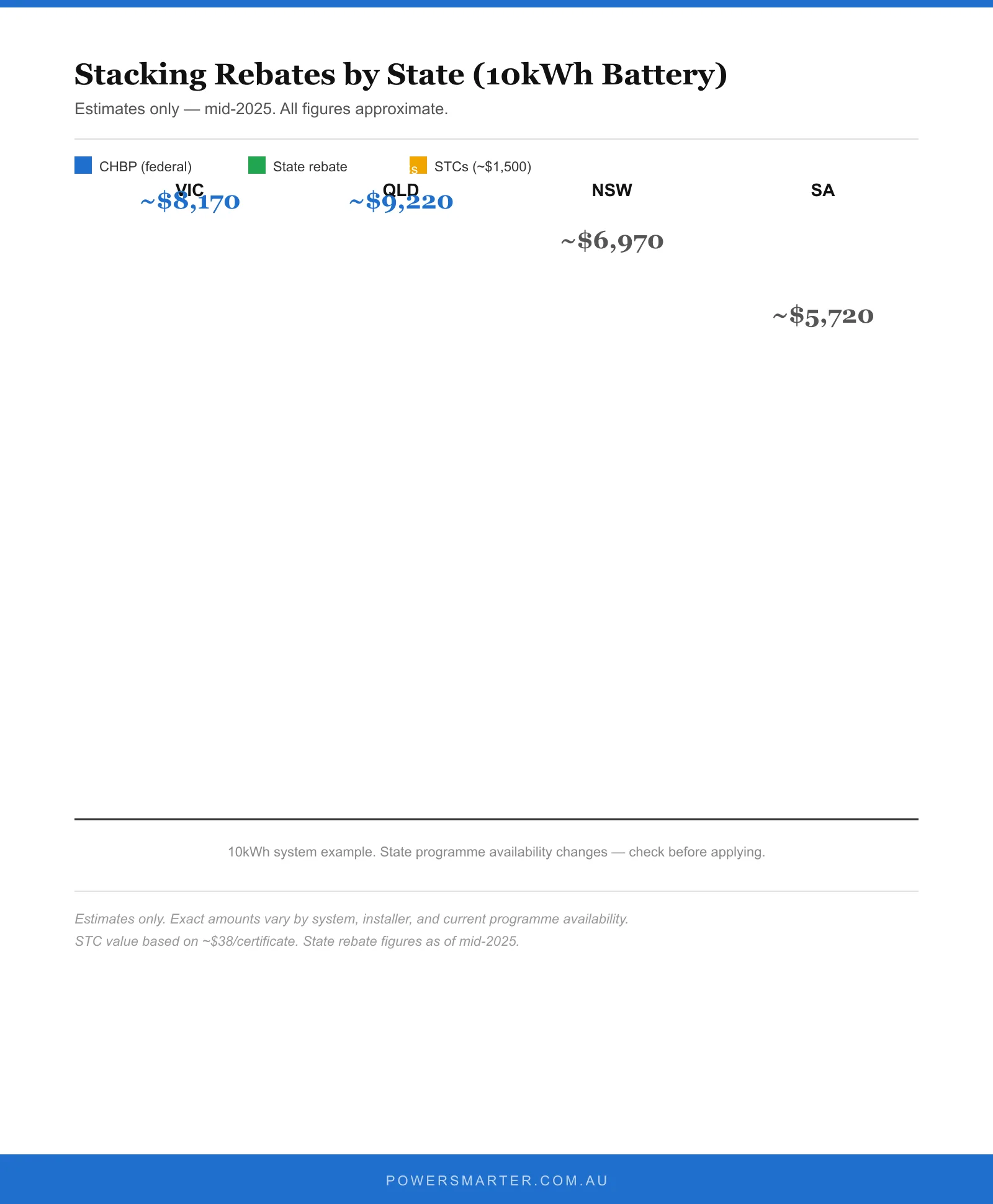
| State | CHBP | State Rebate/Incentive | STCs | Approx. Total Savings (10kWh) |
|---|---|---|---|---|
| VIC | ~$3,720 | Up to $2,950 | $1,500–$3,000 | $8,000–$10,000 |
| QLD | ~$3,720 | Up to $4,000 | $1,500–$3,000 | $8,000–$10,000 |
| NSW | ~$3,720 | $1,000–$2,500 (PRCs) | $1,500–$3,000 | $6,000–$9,000 |
| SA | ~$3,720 | VPP credits (ongoing) | $1,500–$3,000 | $5,000–$7,000 upfront + ongoing |
These are estimates only. Certificate values fluctuate; state programme availability changes.
The takeaway is straightforward: stacking is usually possible, and the combined value can be genuinely substantial. But don't assume — confirm with your installer and relevant state authority that both programmes are available and compatible for your specific situation.
Got questions about home batteries or solar? Use our free quote comparison tool to get matched with accredited local installers — no spam, no sales calls unless you want them.
Comments (0)
No comments yet. Be the first to share your thoughts!