
Australia's Federal Home Battery Rebate: What You Actually Need to Know
Two days ago, on 21 May, the federal government officially announced the Cheaper Home Batteries Programme (CHBP). My inbox has been busy ever since.
"Is it real?" "Do I qualify?" "Should I wait until July?" Fair questions, all of them. So let me break this down properly, because there's a lot of noise right now and not much signal.
What the CHBP Actually Is
The Cheaper Home Batteries Programme is a federal subsidy that reduces the upfront cost of installing a home battery system. It works like the existing STC rebate for solar panels — meaning the discount gets applied at the point of sale by your installer, so you don't have to claim anything back yourself. The government reimburses the installer later. Clean and simple, in theory.
How Much Money Are We Talking?
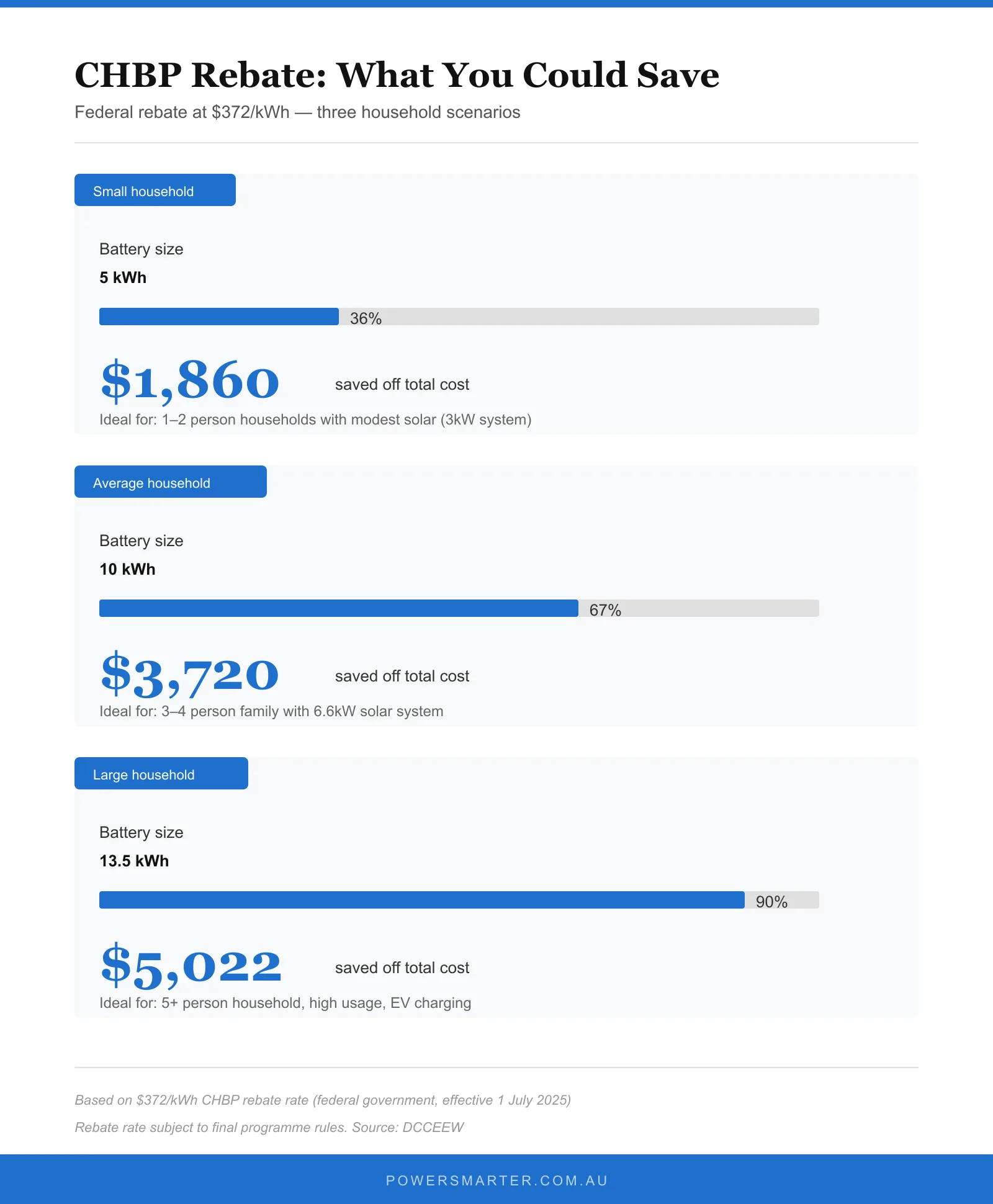
The rebate is structured around battery capacity. The government has announced $372 per kilowatt-hour of usable battery capacity (the exact figure may adjust slightly once the full program rules are published, so worth checking the official DCCEEW website as we get closer to July).
For a typical 10kWh battery — which is what most households with 6.6kW solar systems end up with — that's roughly $3,720 off the purchase price. Before the rebate, a 10kWh battery installed might cost you $12,000–$14,000 depending on brand and location. So we're talking about a meaningful chunk, not a token gesture.
Larger systems get more. A 13.5kWh Tesla Powerwall, for example, would receive closer to $5,000. A 20kWh system even more.
When Does It Start?
1 July 2025.
That's the date the programme goes live. Not tomorrow, not next week — 1 July. If you're in the middle of planning a battery installation right now, you've got a bit of time to get your ducks in a row.
Don't let anyone pressure you into rushing before that date just to "lock in" a price, unless the deal genuinely makes sense without the rebate attached.
Who Can Apply?
Here's where it gets a bit more nuanced.
There is no income test. The CHBP is available to households regardless of income — as well as small businesses and community organisations. This is a common point of confusion, because some state-level schemes (such as Victoria's Solar Homes program) do have income limits. The federal CHBP does not.
Off-grid eligibility: Both grid-connected and off-grid battery installations are eligible under the CHBP — so households not connected to the grid can still access the rebate.
Capacity cap: The rebate applies to the first 50 kWh of usable storage capacity. For most households (5–20 kWh systems), this cap is irrelevant — but if you're considering a very large system, the subsidy does not continue scaling linearly beyond 50 kWh.
You'll also need to have a rooftop solar system already installed, or be installing one at the same time as the battery. The CHBP isn't designed for standalone batteries without solar — the whole point is to help households store their own solar generation rather than export it to the grid for peanuts.
The programme is primarily designed for owner-occupiers. Renters are generally not eligible, as the rebate requires the battery to be installed at a property you own. Businesses and community organisations have their own defined eligibility pathway. Strata properties may have additional complexity depending on shared infrastructure — check with your installer.
Why the Government Is Doing This
Feed-in tariffs have cratered. In most states, you're getting somewhere between 3 and 8 cents per kWh for solar you export, while paying 25–35 cents to buy power back at night. The economics of solar without storage are increasingly less favourable than they were five years ago.
Encouraging home battery uptake also helps the grid — a lot of residential batteries can act as a distributed demand-response resource, which helps manage those chaotic afternoon peaks when everyone gets home and turns on the aircon.
Whether you're cynical about the policy motivation or not, the dollars are real. That's what matters.
What You Should Do Right Now
Honestly? Don't panic-buy anything.
If you've been sitting on the fence about a battery, now is a good time to get quotes, understand what system size makes sense for your household, and confirm you meet the eligibility requirements (owner-occupier, solar installed or co-installing). Do that now and you're ready to move.
If someone calls you in the next few weeks claiming the rebate is "first come, first served" and you need to sign today — be sceptical. The full programme rules haven't even been published yet.
We'll be watching the DCCEEW announcements closely and updating our coverage as more details emerge. Right now, this is what we know.
Got questions about home batteries or solar? Use our free quote comparison tool to get matched with accredited local installers — no spam, no sales calls unless you want them.
Comments (0)
No comments yet. Be the first to share your thoughts!