
Why Sitting on the Fence About a Home Battery Might Cost You More Than You Think

I'm not in the business of telling people to rush into purchases. If your finances aren't right, or you're genuinely uncertain whether a battery suits your situation, then wait. Full stop.
But "I'll look into it next year" is not a neutral position. And I think a lot of people treat it like one.
Here's what the fence actually costs you.
The STC Problem
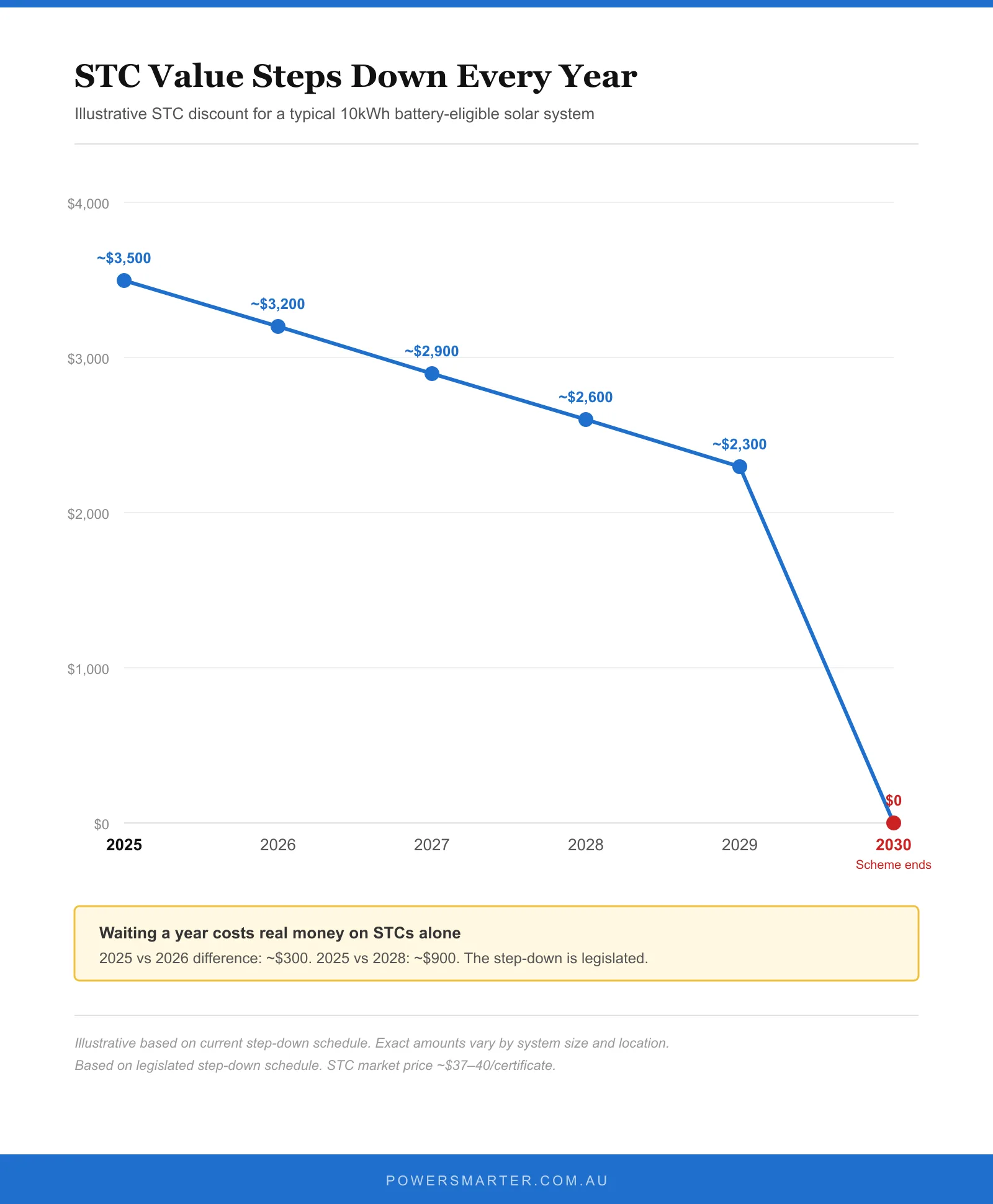
Small-scale Technology Certificates — the rebate mechanism that's been discounting solar and some battery installations for years — has a countdown clock built into it. The scheme legislates a step-down every January 1st, reducing the number of certificates a system is eligible to create. It runs until 2030, when it ends entirely.
What does that mean in dollars?
In 2025, a typical solar-plus-battery installation might generate STCs worth around $2,500–$4,000, depending on location and system size. By 2026, that number will be lower. By 2027, lower again. The reduction each year isn't catastrophic — usually a few hundred dollars — but it's not nothing either. And it compounds across multiple years of procrastination.
If you wait from mid-2025 to mid-2026, you're looking at losing somewhere in the range of $300–$600 in STC value on a typical system, roughly speaking. Doesn't sound massive. But pair that with the next issue and it starts to add up.
The CHBP Has a Budget Cap
The Cheaper Home Batteries Programme isn't open-ended. The federal government has allocated a specific funding pool — the current announcement is part of a broader $2.3 billion package, but the individual household rebate component has limits on how many systems it will fund.
This matters because demand is going to spike hard once 1 July hits.
Australia has somewhere around 3.5 million rooftop solar installations right now (according to the Clean Energy Regulator's statistics), and a much smaller proportion have batteries. The backlog of households who've been waiting for exactly this kind of rebate is substantial. I wouldn't be surprised if the first funding tranche gets heavily committed within the first few months.
That's not a scare tactic. It's just how these programs have worked historically — look at what happened with the Victorian Solar Homes Programme when it first launched. Applications outpaced funding within weeks.
Does that mean you'll miss out entirely if you wait? Maybe not. The government may top up funding if uptake is strong. But "they'll probably add more money" is a risk to carry, not an assumption to rely on.
What You're Paying on Your Bill in the Meantime
There's a third cost to waiting that people often don't account for: the ongoing electricity bill you're paying while you delay.
Let's say a 10kWh battery saves you $1,200 a year on your bill (a conservative estimate for a household paying 30c/kWh with decent solar generation, shifting half their import to stored solar). If you wait 12 months to install, that's $1,200 you paid to the retailer that you could have kept.
Not a reason to install if the system doesn't suit you. But if you're already convinced a battery makes financial sense for your house, every month of delay is money left on the table.
The Counter-Argument (Worth Being Fair)
Battery technology is improving. Prices have trended down over the past several years — though that rate of decline has slowed considerably since 2022 and certainly isn't guaranteed to continue at the same pace. And grid export tariffs (feed-in tariffs) keep dropping, which actually strengthens the case for batteries over time, not weakens it.
So the counterpoint is: wait a couple of years, and maybe batteries are slightly cheaper and the grid economics are even more favourable.
My take? That argument has merit if you're talking about a 5+ year timeframe. But right now, with the CHBP landing on 1 July and STCs still at 2025 values, the rebate combination available this year is genuinely the strongest it's been. And possibly the strongest it'll be for some time.
The Actual Suggestion
Not: panic-buy something before you've thought it through.
Rather: if a battery has been on your "maybe someday" list, the next four to six weeks is a good time to actually do the research. Get quotes. Check your eligibility. Understand what size system makes sense for you.
Then on 1 July, you're making an informed decision rather than scrambling.
That's very different from sitting on the fence and hoping the situation gets better on its own.
Got questions about home batteries or solar? Use our free quote comparison tool to get matched with accredited local installers — no spam, no sales calls unless you want them.
Comments (0)
No comments yet. Be the first to share your thoughts!