
Is a Home Battery Actually Worth It in 2025? (An Honest Look at the Numbers)
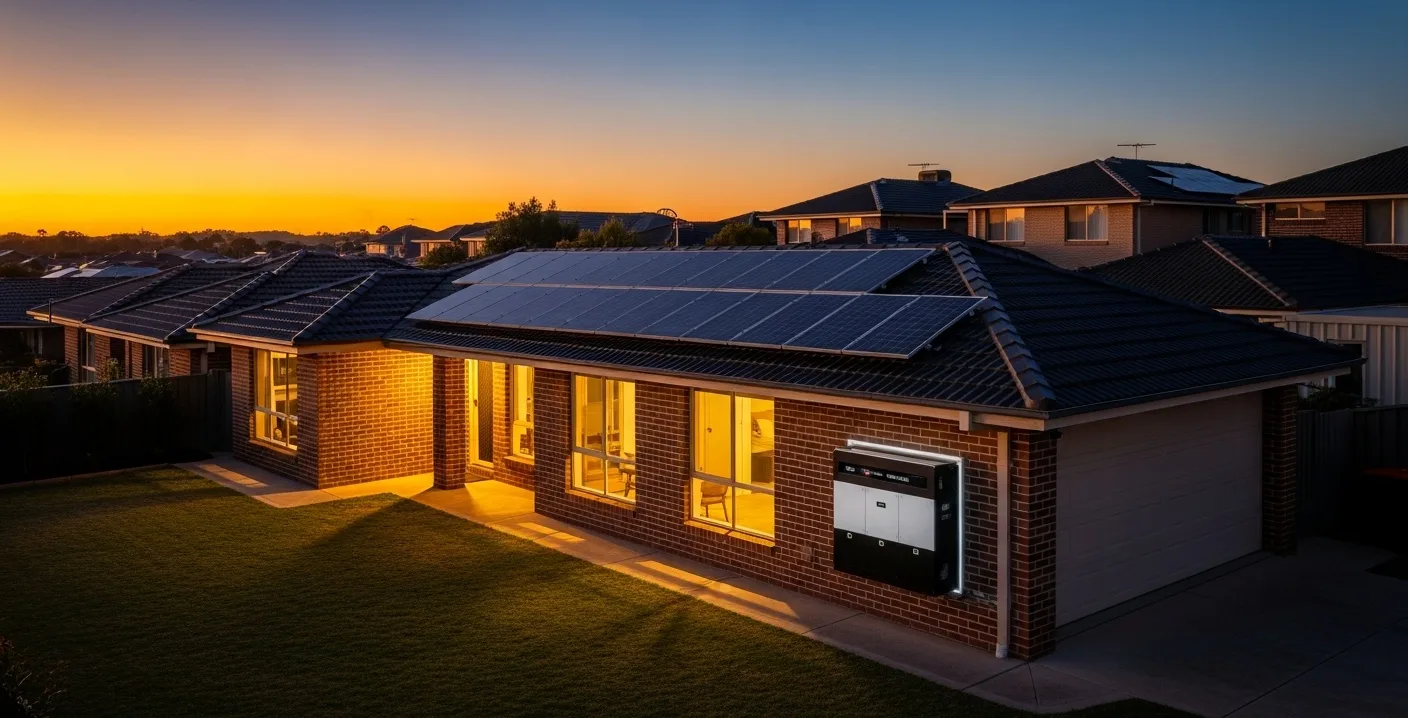
Here's my honest take: a home battery is worth it for some households, not for others, and the marketing from both enthusiasts and sceptics tends to overstate their case.
Let me give you the numbers and let you work it out.
The Basic Economics
A home battery makes money for you in one way: by reducing how much electricity you buy from the grid at expensive retail rates (currently 25–35 cents per kWh in most Australian states).
Instead of exporting your surplus solar during the day at 3–8 cents per kWh (feed-in tariffs have cratered since 2019), you store it and use it at night, effectively "selling" it to yourself at the full retail rate. The economic gain per kWh is the difference between the retail rate and the feed-in tariff — roughly 18–30 cents per kWh, depending on your tariff.
If a 10kWh battery gets fully cycled every day and you save 22 cents per kWh cycled, you're saving:
10 kWh × $0.22 × 365 days = $803 per year
Real-world bill savings for a typical household with a 6.6kW solar system and a 10kWh battery tend to land in the $1,000–$1,600 per year range.
Payback Periods: The Real Picture
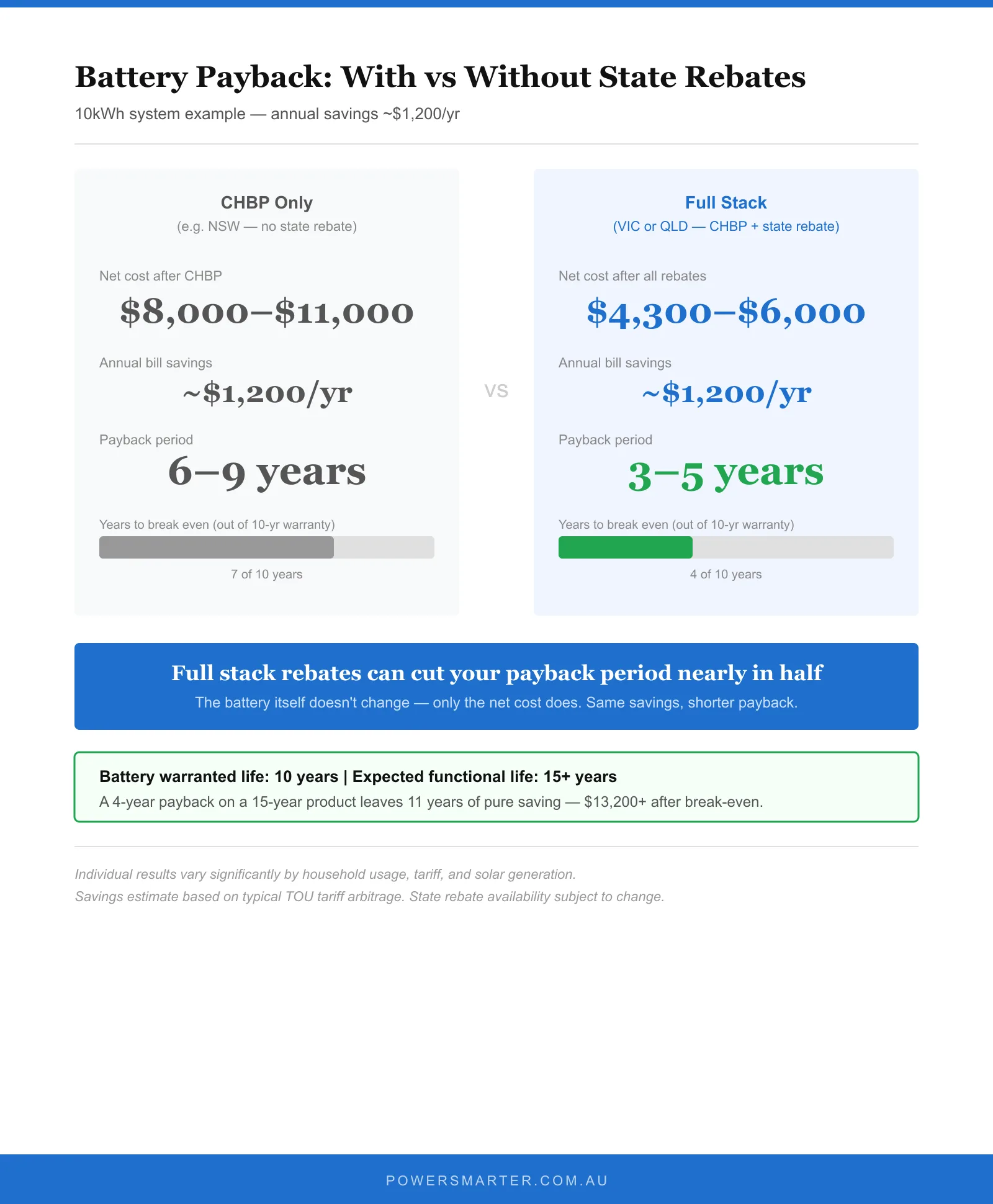
At a net cost of $8,000–$11,000 (after CHBP rebate, no state rebate), a 10kWh battery saving $1,200/year is looking at a payback period of 6.5–9 years.
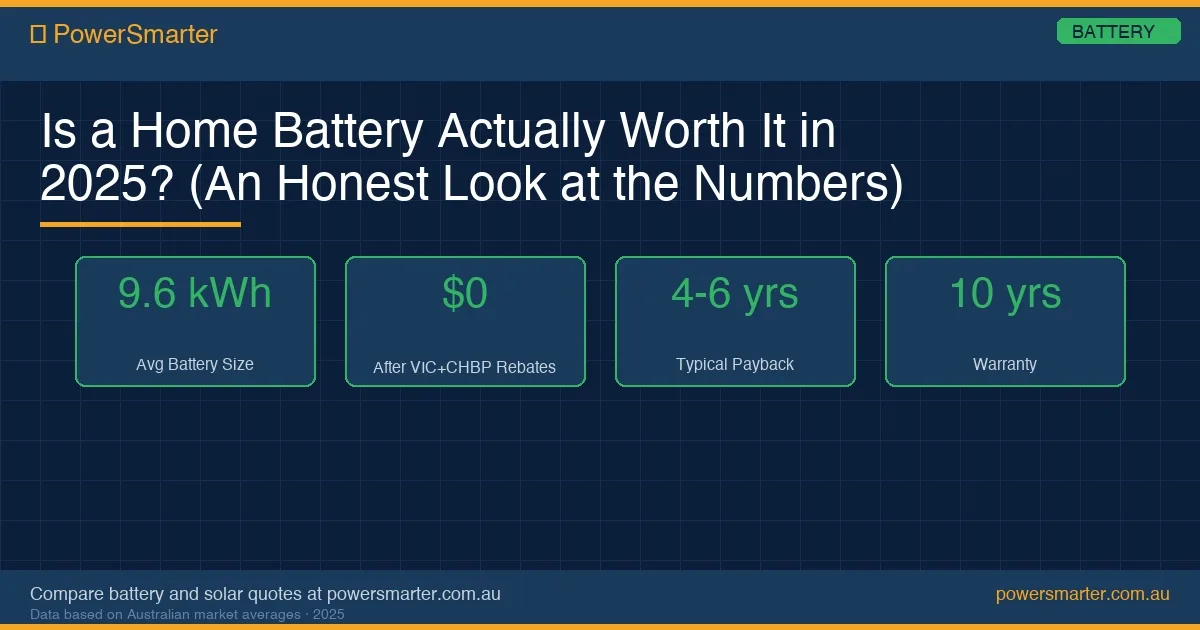
With state rebates stacked (Victorian scenario, net cost around $4,300–$6,000), that drops to 3–5 years.
The battery's warranted life is typically 10 years. The expected functional life is often 15+ years.
- 6–9 year payback, 10-15 year functional life: Modest financial case. Not a slam dunk.
- 3–5 year payback, 10-15 year functional life: Strong financial case.
When It Definitely Makes Sense
You're on a time-of-use tariff with high peak rates. Some retailers now charge 40–50 cents per kWh during evening peaks. A battery that allows you to avoid that peak entirely is doing serious work.
You've got a high electricity bill and good solar generation. If you're paying $300+ per quarter and your solar is mostly being exported, there's real money to capture.
You're in Victoria or Queensland with stacked rebates. The maths is genuinely compelling with CHBP + state rebate + STCs all applied. Payback under 5 years is realistic.
You care about blackout protection. If your household has medical equipment, you run a home business, or you live in an area with unreliable grid supply — the value of backup power isn't captured in the ROI calculation but it's very real.
When the Numbers Are Harder to Justify
You have a small solar system (3kW or less). A battery needs enough solar generation to charge properly.
You're on a flat tariff with a decent feed-in rate. The economic arbitrage between storing vs. exporting is smaller.
You're planning to move in 2–3 years. Batteries may add some value to a property sale, but they don't recover their full cost.
You can't access CHBP or state rebates. At full price, a $13,000 battery saving $1,200/year has a 10+ year payback — borderline for a 10-year-warranted product.
The Intangible Factor
There's something that doesn't show up in spreadsheets: for a lot of people, watching the battery indicator fill during the day and drain at night is genuinely satisfying. The reduced anxiety about energy bills. Not being completely dependent on the grid. The smug feeling when there's a blackout and your lights stay on.
I'm not dismissing that. For some households, those factors are worth several hundred dollars a year. For others, they're not particularly important.
What I'd resist is letting those feelings drive a decision that doesn't actually stack up financially.
My actual answer to "is it worth it?" for most households in 2025, especially post-CHBP: for the right household, yes — more strongly than at any previous point. For some households, still no. Get a proper quote, run the numbers for your specific situation, and decide with your eyes open.
Got questions about home batteries or solar? Use our free quote comparison tool to get matched with accredited local installers — no spam, no sales calls unless you want them.
Comments (0)
No comments yet. Be the first to share your thoughts!