
Getting Solar Battery Quotes in Australia: How to Not Get Ripped Off

The CHBP announcement has been fantastic for genuine solar and battery companies. It's also been a windfall for dodgy operators who smell an opportunity.
I don't want to be overly cynical — most people working in the solar industry are legitimate. But the combination of government rebates, consumer confusion, and high-pressure sales tactics creates conditions where things go wrong. And they go wrong often enough that consumer advocacy groups have been warning about it for years.
So let me tell you what I'd be looking for if I were getting battery quotes right now.
Get At Least Three Quotes
This isn't bureaucratic caution. It's because the variation in pricing for identical or equivalent systems is genuinely significant — we're often talking $2,000–$4,000 difference between the cheapest and most expensive quotes for the same outcome.
Three quotes gives you a baseline for what's reasonable. One quote gives you no reference point at all. Two quotes sometimes just tells you one is cheaper than the other, without telling you which is fair.
What a Good Quote Should Actually Include
A solid battery quote should give you, in writing:
- Brand and model of the battery (not just "10kWh lithium battery")
- Usable capacity (not just rated capacity — these can differ)
- Warranty terms: typically 10 years for the battery, separate warranty for the inverter if applicable
- Inverter brand and model (if applicable)
- Installation inclusions: Does it cover switchboard upgrades if needed? Metering? Compliance certificates?
- Total installed price including GST
- Rebates applied: CHBP amount as a line item, STCs, any state rebates — all separately identified
- Net price you pay after all rebates
If a quote gives you a single lump-sum number with a handwritten note saying "includes government rebate," that's not a quote. That's a starting point for a negotiation where you don't know the rules.
Red Flags That Should Give You Pause
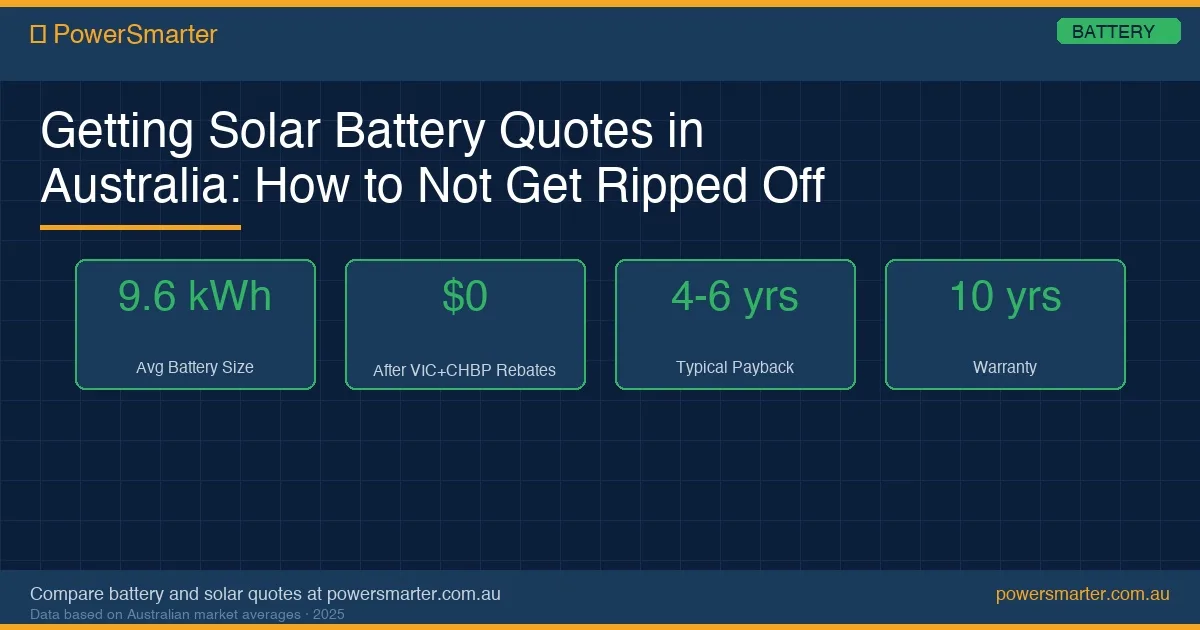
"This offer expires tomorrow." A legitimate offer can be held for a reasonable decision period. Artificial urgency is a classic high-pressure tactic. Take your time.
Rebate numbers that seem too high. If someone is quoting you a $8,000 "government rebate" on a $13,000 battery when the CHBP + STCs should add up to about $5,000–$6,000, ask them to itemise where every dollar comes from. If they can't, the number is made up.
No mention of CHBP accreditation. From 1 July, if an installer is claiming to apply the CHBP rebate, they need to be registered under the programme. Ask directly: "Can you show me your CHBP registration?" If they're cagey, walk away.
Quote doesn't include compliance costs. Some installers quote a low headline price and then hit you with "we need to upgrade your switchboard" or "there's a permit fee" after you've signed. Ask upfront: "Is there anything that could add to this price after I sign?" Get any inclusions confirmed in writing.
Promising the rebate before 1 July. The CHBP starts 1 July 2025. Any installer claiming they can apply it to an installation before that date is either confused or misleading you.
Pushing a specific brand hard without explaining why. There are good reasons to choose one battery over another — but if the installer can only tell you about one brand and gets evasive when you ask about alternatives, consider why that might be. (Usually: margin.)
How to Compare Quotes Properly
- Normalise for battery size: If one quote is for 10kWh and another is for 13.5kWh, they're not directly comparable. Calculate a $/kWh installed cost.
- Check what's included: Does the expensive quote include a switchboard upgrade that the cheap one doesn't? Is the warranty twice as long?
- Check the battery brand reputation: A 10kWh battery from a manufacturer with no Australian service centre is not equivalent to one from Tesla or BYD.
- Ask about after-sales support: Who do you call if the battery develops a fault in 18 months?
The Comparison Platform Question
I'll be transparent: PowerSmarter is a comparison platform, so I have a dog in this race. But independent quote comparison services — ours included — exist precisely because getting three quotes yourself is a significant time investment for most busy households.
A legitimate comparison platform should:
- Be transparent about how it makes money (referral fees from installers, not from you)
- Not recommend only one installer
- Be willing to tell you if a quote from one of their partners is too expensive
If a comparison site pushes you hard toward a single installer without showing alternatives, it's functioning more like a lead-generation service than a genuine comparison tool.
There's real money available for Australian households right now through the CHBP and related schemes. Don't let the urgency and the noise around it push you into a decision that benefits the installer more than it benefits you.
Got questions about home batteries or solar? Use our free quote comparison tool to get matched with accredited local installers — no spam, no sales calls unless you want them.
Comments (0)
No comments yet. Be the first to share your thoughts!